
Should I use weed and feed on my perth lawn?
Should I Use
Weed and Feed?
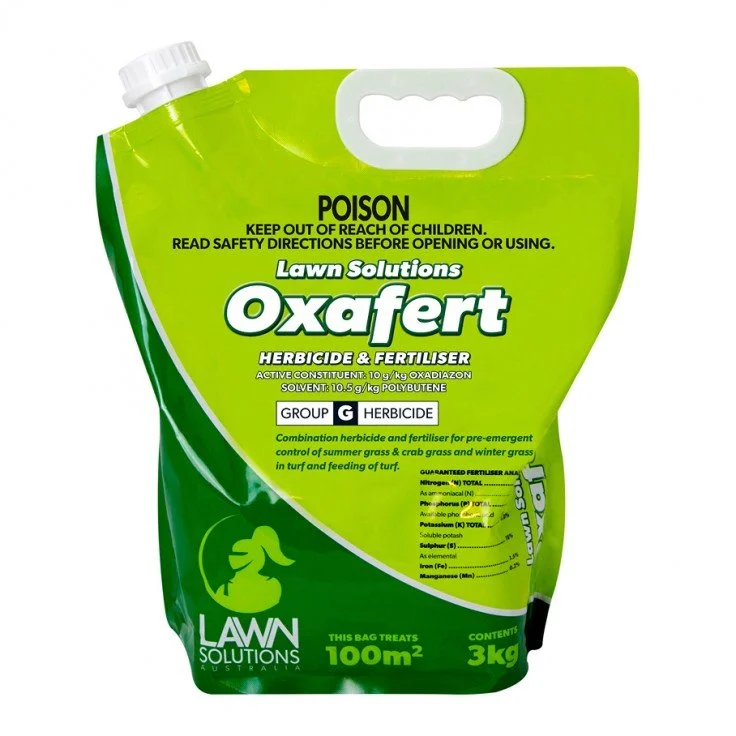
Weed and feed products are one of the most heavily marketed lawn care products in Australian hardware stores. The pitch is straightforward: one product handles both your weed problem and your fertilising in a single application. Less time, less effort, fewer products to buy.
It's a compelling idea. But on Perth's sandy soils, in our warm climate, and with the turf varieties grown here, the reality is that weed and feed rarely delivers the results that two separate, purpose-built products would. In most cases you end up with a compromise on both the weed control and the fertiliser — neither done as well as it should be.
Here's why, and what to use instead.
Weed and feed products require both the weeds and the lawn to be in exactly the right condition at the same time — which almost never happens on Perth lawns. A dedicated broadleaf herbicide targets actively growing weeds at the right concentration. A dedicated fertiliser feeds the lawn at the right rate for the season. Using both separately takes an extra 20 minutes and produces significantly better results in both areas.
What weed and feed actually is
Weed and feed is a granular product that combines a herbicide — usually targeting broadleaf weeds — with a granular fertiliser. The idea is that you spread the granules across the lawn, the herbicide kills the weeds and the fertiliser feeds the grass simultaneously.
The problem is that these two jobs have fundamentally different requirements in terms of timing, application rates, soil moisture and temperature. Bundling them into a single application means accepting a compromise on both. And on Perth's sandy, free-draining soils and in our warm, variable spring climate, those compromises matter more than they would in cooler, more uniform conditions.
Five reasons to use separate products on Perth lawns
Granular fertiliser, on the other hand, needs to be applied when soil temperatures are warm enough for the grass to take up nutrients — generally above 15 degrees. But the timing, rate and formulation of the ideal spring feed has nothing to do with whether broadleaf weeds are present. When you combine them into a single product, you are applying both according to one timing decision — which means at least one of them is being applied at a suboptimal time.
This creates an impossible situation: if you water in to activate the fertiliser, you reduce the herbicide's effectiveness. If you don't water in, the fertiliser leaches through before the roots can absorb it, or just sits on the surface in Perth's heat. Either way, one of the two jobs is being done poorly.
With separate products, you spread your fertiliser at the rate your lawn needs and apply your herbicide at the rate the weeds need. Two independent decisions, both made correctly.
A selective post-emergent broadleaf herbicide applied through a sprayer or hand bottle puts product exactly where the weeds are, at the right concentration, without affecting the rest of the lawn. It's more targeted, more effective and uses less product overall.
With a dedicated broadleaf herbicide, you choose a product that is specifically labelled as safe for your variety. Dedicated herbicides for buffalo turf are well established, widely available and clearly labelled. A weed and feed product that has blanket compatibility claims should always be treated with caution on buffalo lawns.
The comparison at a glance
| Factor | Weed and Feed | Separate Herbicide + Fertiliser |
|---|---|---|
| Timing flexibility | ✗ Both applied at once — one is usually suboptimal | ✓ Each applied at the right time for its job |
| Application rate control | ✗ Herbicide rate locked to fertiliser rate | ✓ Each applied at the correct independent rate |
| Perth sandy soil performance | ✗ Watering conflict between herbicide and fertiliser activation | ✓ Each product managed to its own watering requirement |
| Targeting accuracy | ✗ Broadcast across the whole lawn regardless of weed location | ✓ Herbicide applied only where weeds are present |
| Buffalo compatibility | ✗ Many formulations risk damaging buffalo turf | ✓ Buffalo-safe herbicides clearly labelled and available |
| Weed control effectiveness | ✗ Diluted concentration, imprecise application | ✓ Full concentration at correct rate for the target weed |
| Fertiliser effectiveness | ✗ Rate and timing compromised by herbicide component | ✓ Chosen and applied for exactly what the lawn needs |
What to use instead
The better approach for Perth lawns is straightforward: identify what you need to treat, choose a dedicated herbicide for the specific weed problem and apply it independently from your fertilising program. Then apply your fertiliser at the right rate for the season with the right formulation for your soil and variety.
For spring in Perth, the two most common weed targets are broadleaf weeds — bindii, clover, capeweed, dandelion and creeping oxalis — and grass weeds like wintergrass and summer grass. These require different products and different timing, which is another reason a generic weed and feed rarely addresses both effectively.



Week 2: Apply Knights Coastal Mix at the recommended spring rate. Water in immediately and thoroughly.
Week 3-4: Spot spray any visible broadleaf weeds with a dedicated selective post-emergent herbicide labelled for your turf variety.
Week 4-5: Apply Exceed liquid fertiliser as a foliar top-up to sustain colour and push growth through peak spring.


Buffalo.
Get the right products for your lawn
Shop dedicated herbicides
and fertilisers online.
All products available with delivery across Perth, or come in to our Wangara showroom for advice. Our team can help you work out the right treatment program for your variety and weed situation.